
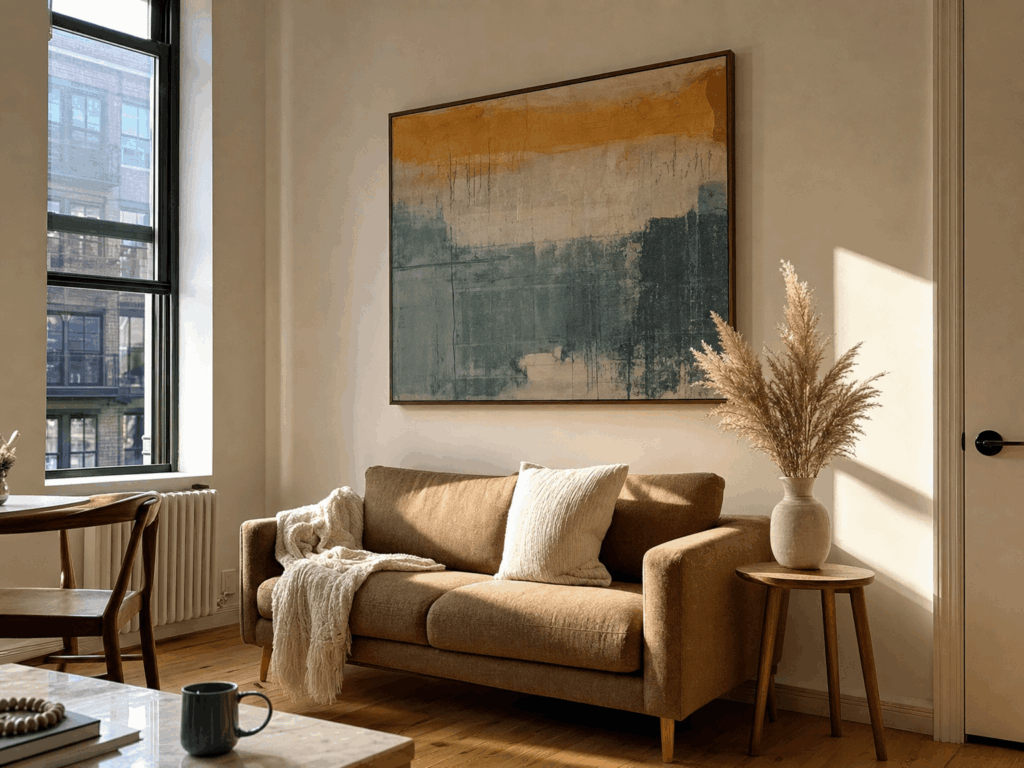
Small rooms have a way of exposing every decorating decision you make, and nowhere is that more true than with art. In a sprawling loft, a slightly-off choice can hide behind square footage. In a compact apartment, the wrong piece announces itself the moment you walk in, like a guest who talks too loudly at a dinner party. The good news is that small spaces are actually easier to get right than big ones, because the rules are clearer and the stakes are more visible. You need fewer pieces, you need them at the right scale, and you need to think about light and viewing distance in a way that people with cavernous living rooms never bother to. This guide walks room by room through the decisions that matter, and makes an honest case for something the design world does not say often enough: one good piece, hung with generous air around it, will almost always beat a busy gallery wall in a tight room.
Start With Scale, Not Style
Before you fall in love with a painting, measure your wall. This sounds unromantic, but scale is the single most common mistake people make in small spaces, and it runs in both directions. A tiny print floating alone on a large blank wall looks lost and apologetic, like it wandered in from a hotel corridor. An oversized canvas crammed between a doorframe and a bookshelf feels claustrophobic, pressing on the room instead of opening it. A reliable starting point is to aim for artwork that fills roughly two thirds to three quarters of the visible wall space above a piece of furniture, and to hang it so the center of the work sits at eye level, which for most people lands around 145 to 152 centimeters from the floor. In small rooms, err slightly toward the larger end of what feels comfortable. Counterintuitively, one confident medium or large piece can make a small room feel bigger, because it gives the eye a single destination instead of a cluttered itinerary. Many small scattered items chop the wall into fragments, and fragmented walls read as busy, which reads as small.
Viewing Distance Changes Everything
In a compact home, you rarely stand three meters back from anything. You see your art from a meter away while brushing past it, or from an armchair barely across the room. This changes what kind of work will reward you. Detailed pieces, works on paper, intricate line drawings, small textured paintings, and photography with fine grain all thrive at close range, because you can actually see what makes them good. Sweeping abstract works designed to be read from across a ballroom can lose their logic when your nose is practically touching them. Before buying, stand at the actual distance you will view the piece in your home, not the flattering distance of a gallery floor. If the work still holds your attention up close, if it gives you something new each time you pass it, it belongs in a small space. If it only makes sense from far away, let it go find a bigger house.
Light Is Half the Artwork
Light in small rooms is often awkward: one window, one overhead fixture, and a lamp doing overtime in the corner. Work with what you have rather than against it. Direct sunlight will fade works on paper, textiles, and many photographs over time, so keep delicate pieces off the wall that gets blasted every afternoon. Glass and acrylic glazing create glare, and in a narrow room you cannot step sideways to escape a reflection, so consider museum glass, matte finishes, or unglazed canvas for walls that face windows or bright fixtures. If a wall sits in shadow, do not write it off. A small picture light or an adjustable spotlight can turn a dim corner into the most atmospheric spot in the home, and darker, moodier works often look better in low light than they ever would in full sun. The rule of thumb: bright walls suit bold color and strong contrast, shadowed walls suit depth, texture, and intimacy.
A Room-by-Room Guide
The Entryway
The entry is where art earns its keep fastest, because it sets the tone in about two seconds. Entryways are usually narrow, so choose vertical formats that echo the proportions of the space, and hang a single striking piece rather than a cluster that people will brush against with their coats. Since viewing distance here is often less than a meter, this is the perfect home for something detailed and rewarding up close. If the entry has no natural light, a warm picture light instantly makes the whole apartment feel considered rather than cramped.
The Living Room
This is where the case for one good piece is strongest. In a small living room, the sofa wall is your main stage, and a single work at roughly two thirds the width of the sofa, hung 15 to 25 centimeters above the backrest, anchors the entire room. Give it air. Empty wall around a strong piece is not wasted space, it is the frame that lets the work breathe and lets the room feel calm. A gallery wall can work in a small living room, but only if it behaves like one piece: a tight grid, consistent frames, a unified palette. Loose, ever-growing salon walls with mismatched frames tend to make compact rooms feel restless. If you are torn, choose the single piece. You can always add later, but you cannot easily subtract clutter from a wall full of nail holes.
The Kitchen and Dining Nook
Kitchens in small homes offer slivers of wall: above a counter, beside a window, over a breakfast table. Small works shine here precisely because the viewing distance is short and the moments are frequent. A single small painting or print near the table gets seen more often than anything else you own, so pick something you genuinely like rather than something merely inoffensive. Avoid unsealed works on paper right next to the stove, where steam and grease are unkind. Framed pieces behind glass, ceramics on a shallow shelf, or a sturdy canvas hold up better.
The Bedroom
Bedrooms reward restraint. Above the bed, one horizontal piece at about half to two thirds the width of the headboard is the classic move, and it works because it is calm. Since you view bedroom art mostly while lying down or in soft evening light, favor works with quiet depth: muted palettes, gentle abstraction, tonal photography. This is not the room for your loudest purchase. It is the room for the piece you want to be the last thing you see at night.
The Bathroom and Hallway
Do not neglect these small transitional zones, because they are where a single modest piece can feel like a delightful secret. In bathrooms, humidity rules out delicate originals, so choose framed prints behind sealed glass or humidity-tolerant media. Hallways, viewed in motion and at close range, love a rhythm of two or three small works spaced evenly, or one piece placed exactly where the corridor ends, giving the eye a destination.
The Case for One Good Piece
Here is the honest truth that maximalist mood boards will not tell you: in a small space, editing is the whole game. One well-chosen work with generous empty wall around it communicates confidence, while a crowded wall communicates anxiety about empty space. A single strong piece also becomes something rarer, a daily relationship. You notice its details in morning light, its mood in the evening, and over the years it becomes part of how the home feels rather than mere decoration on it. If your budget allows one meaningful original instead of five forgettable prints, take the original every time. Quality with air around it always outperforms quantity shoulder to shoulder. For those looking to put this into practice, ZUR Gallery makes the search refreshingly simple: the gallery lets buyers browse contemporary Israeli art by the space it is intended for, including art for small spaces, so you can filter for works that were actually selected with compact walls, close viewing distances, and real apartments in mind. It turns the hardest part of the process, finding the right scale for your actual home, into the easy part.
Final Thought
A small home is not a limitation on collecting art, it is a filter for it. It forces you to ask the only question that ever really mattered: do I love this enough to see it every single day, up close, in my own light? Measure the wall, respect the light, stand at your real viewing distance, and when in doubt, choose the one good piece and give it room to breathe. Your small space will feel larger, calmer, and unmistakably yours.


